Showing posts with label Medical Stories. Show all posts

July 7, 2010

My Final Answer

I know it may not look like much is going on here in this blog, but I continue to get e-mails from people asking the same question:

As a doctor, when's the best time to have baby? Before or during medical school? How about during residency or as an attending physician? Which specialty should I go into based on my desire to have kids?

I think I have my final answer, really, the end all be all answer. It's beyong cliché. . . but here goes: Accept your callings in life.

If you're a family wo/man, have a family. If you always saw yourself with six kids, think about how much time that would take and subtract it from the latest you'd like to be pregnant and go to it. Something will work out, it alway does. Yes, it will be unbelievably hard, but chances are if you signed up to become a doctor you're a glutton for punishment anyway.

This blog has been brutally honest (as I've been told) about the challenges of becoming a physician while trying to start/raise a family. So long as you go into this process with your eyes wide open, good coping skills, and at least one supportive buddy everything will turn out fine.

Deal with the fact that you'll miss 'firsts.' -You should have known that when you sent in your medical school application. Since none of us remember if mommy and daddy were there when we began walking, just remember that you're more likely to suffer emotional damage than Junior when it comes to absenteeism in the first years.

What children need, says me, are parents who give them their best selves in their formative years (generally accepted as age 3 and beyond). This doesn't necessarily mean, but doesn't exclude, staying at home with them. If you were called to be a homemaker, do it. If you were created to be a doctor, do it. It really doesn't matter what occupation you find yourself in so long as you set a good example of using your talents and giving examples of service. Consider the opposite: A mother who resents her children because they kept her from her career aspirations, or the work-horse who returns home too burnt-out and bitter to enjoy her kids.

The trick here is to choose a specialty (or profession for everyone else) that will build you up to be a better person. -This is where the caveat to my final answer comes. If God blessed you with the skills of a surgeon, but the lifestyle would make you and everyone else miserable, don't do it. Pick the next thing on your list of favorites. Trust me.

Finally, doctoring isn't always the thorn in the side of parenthood. The one perk to being a resident mommy is that when I have to say goodbye to my son, I can always tell him that I must go help others who are less fortunate. I was on-call last night and missing my little guy terribly when I was summoned to see a six-year old boy who was complaining of pain at his gastric-tube site. On the way to his room I saw several children with broken skulls and displaced eyes. You better believe when I came home I held onto his perfect little body longer and with more appreciation than I would have otherwise.

Coming eventually:
  • Patriotism and Decluttering - A match made in heaven.
  • Living life pre- and post-call
  • Are women the cause for the healthcare crisis?
  • The "I can't seem to lose this stomach so I'll just have another baby" option.

October 25, 2009

Back from Conference!


Sorry about the pause in posts (did anyone notice?), I just got back from a medical conference in Austin, TX. There's me with my poster about a device that can help paralyzed patients get around, and with a fellow resident mommy!

Many, many way cool pictures to follow. . .

September 29, 2009

Young Children are like Brain Injury Patients


A lot to learn, or re-learn

I used to get asked a lot why I'm so good with kids before I became a mother. The truth is, my medical training has prepared me in this regard. Young children have a lot of connections to make in their brains, much like my brain injury and stroke patients. These are my gems for interacting with both groups of people:
  • Give positive commands
    Instead of saying "don't step in that puddle," say "walk around that puddle, please." It's harder for the human mind to process negative statements.


  • Prepare them for new situations
    I've seen mothers become mortified when their kids run wild around a restaurant. This could be avoided, or at least minimized, if the children are given instruction as to what to expect and do when going out to eat. Remember that the developing mind handles new environments by comparing and contrasting to previous experiences. Thus if the dining booth looks like a fun hide-out or the row of chairs appears to be a jungle-gym, you know what follows. If, however, you talk about what's appropriate for dining out and even give a preview then the chance that you'll need to pry your child off the waiter will diminish.


  • But don't explain too much.
    Keep things developmentally appropriate or confusion/fear may develop about a situation. Example: "On the airplane they teach us how to be extra safe." -That's better than "pay attention to these instructions, you might need them in case of an emergency."


  • Offer lots of encouragement
    When the world doesn't seem like it's built for you, this can take its toll. Kind words to bolster up the spirit are necessary to get through life's challenges.


  • Be patient, let them work it out
    It's easy to fill in sentences or help with tasks when it takes longer for someone else to do this alone. Unfortunately, this only fosters dependence.


  • Do it the same way every time
    If you're teaching someone how to tie their shoes, do it one way each time you repeat a lesson. This is how the brain makes connections fastest.


  • When reason fails and hysteria ensues, a dark padded room is best

September 11, 2009

Hangin' with Mr. Cooper


There's not much natural support.

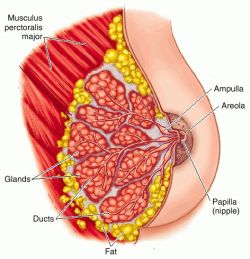
"You sacrificed your boobs, you know." I've been told that a few times since becoming a mother. My fellow residents are the only ones to say it that way. As doctors, we've seen a lot of boobies and the saggy grandmas leave an indelible impression that makes many hesitant to have kids and breastfeed.

The only thing keeping the breast suspended are Ligaments of Cooper that are very, very fine elastic fibers. With time and strain they can give out and cause, what we call, "T4* to the floor."

I'm a big supporter of breastfeeding, but I also don't want to carefully maneuver my cane around my boobs one day. So I take the following steps to fight the good fight against the sag.
  • Rotate bras.
    If you wear the same bra all the time, it loses its support. Also, I invest in the good stuff.
  • Wear a sleep bra at night.
    It doesn't have a strong hold, but it's better than nothing.
  • Use the side-lying position for feeding.
  • If I do breastfeed upright, I bring my baby to my boob and not the other way around.
  • Pump before I get engorged.
  • Not dance like this (courtesy of my friend, Brenda).
*T4 is the spinal cord level that innervates sensation in the nipple.

August 28, 2009

How to Give Your Kid a Spinal Cord Injury:


Purchase one of these.


Let 'em loose with this one.


And use this device while driving.

That's how my pediatric patients got theirs.
(Yet another scare-you-straight post from Resident Mommy)

July 30, 2009

No TB for me!

As part of my return to work process, I had my annual tuberculosis skin test and I was sweating this one.

I was 7 months pregnant with my son when I decided it would be 'cool' to switch out someone's trach myself (instead of calling someone over from ENT). The patient was a recovering alcoholic and past IV drug user so I thought to myself, "hmmm, better gown up and put a mask on for this one." My senior resident actually rolled his eyes when I took these precautions. No sooner had I placed the new trach and started inflating the cuff, the patient panicked and started coughing through her stoma. Blood squirted everywhere, which includes drops landing on my face!!!

I forgot to mention that this patient had tuberculosis that was presumed to be dormant. As I tried to carefully wash the specks of blood away from my eyes I felt like the worst mother in the world for putting my unborn child in harm's way. . . again.*

Now that my boy is here looking healthy and I have this nice flat skin where the TB test was placed, I feel just a tiny bit better about calling myself a parent.

*I have a list!